
How Market Research Helps Businesses Address Subscription Fatigue
Key Takeaways
- Subscription fatigue occurs when recurring payments no longer feel justified by the value customers receive.
- Rising cancellations are not always caused by price; product usage, customer experience, competing services and changing priorities also influence churn.
- Market research helps businesses distinguish subscription fatigue from ordinary customer churn, payment failures and temporary changes in demand.
- Pricing research, customer interviews, behavioural analysis and competitive intelligence reveal which changes are most likely to improve retention.
- Flexible subscription options can protect revenue without relying on repeated discounts.
- HBG Knowledge helps businesses translate subscriber feedback and market data into practical pricing, product and retention decisions.
Subscription fatigue has moved beyond streaming services. It now affects software platforms, membership programmes, digital publications, wellness services, retail subscriptions, education products and business-to-business tools.
Customers are reviewing recurring expenses more closely. They are questioning which subscriptions they use, which ones provide meaningful value and which can be paused, downgraded or cancelled.
Price sensitivity is only part of the problem. Customers may also leave because they are not using important features, find the service difficult to manage, have discovered a better alternative or no longer understand why the subscription deserves a place in their monthly budget.
For subscription businesses, the challenge is not simply to prevent cancellation. It is to identify why perceived value has declined and determine which changes could rebuild it. Market research provides the evidence needed to make those decisions without relying on assumptions.
What Is Subscription Fatigue?
Subscription fatigue describes a customer’s growing reluctance to maintain recurring payments across multiple products or services.
It commonly develops when:
- The total cost of subscriptions becomes difficult to justify
- Several services provide similar benefits
- Prices increase without a clear improvement in value
- Customers use only a small part of what they are paying for
- Billing or cancellation processes create frustration
- Customers feel overwhelmed by the number of plans they must manage
- A competitor offers a simpler, cheaper or more flexible alternative
Subscription fatigue can appear through cancellations, but cancellation is not the only warning sign. Customers may downgrade their plans, switch from monthly to occasional usage, pause their subscriptions or repeatedly cancel and return.
Recent subscription-industry research reinforces the importance of flexibility. Recurly’s 2026 analysis covers 76 million subscribers and more than 2,200 merchants. It found that 71% of consumers considered easy cancellation important when deciding whether to subscribe. Businesses offering a “pause before cancel” option also recorded a substantial increase in subscription pauses, with many paused customers returning within the following months.
Subscription Fatigue Is Not the Same as Customer Churn
Treating every cancellation as subscription fatigue can lead businesses towards the wrong solution.
Customer churn can result from several different conditions:
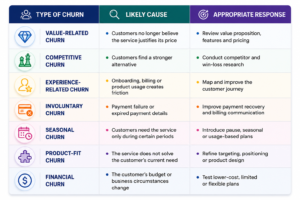
A blanket discount may temporarily retain a price-sensitive customer, but it will not fix poor onboarding, weak feature adoption or limited product relevance.
Research must first establish which type of churn is occurring.
Warning Signs of Subscription Fatigue
Businesses should investigate subscription fatigue when several of the following patterns appear together.
Renewal rates are declining
A gradual reduction in renewals may indicate that customers no longer see enough ongoing value to continue paying.
Downgrades are increasing
Customers moving to lower-priced plans may still value the service but believe their current package contains unnecessary features or has become too expensive.
Customers are cancelling and returning
Subscription cycling occurs when customers leave and later resubscribe for specific content, features, projects or seasonal requirements. This does not necessarily indicate permanent dissatisfaction.
Discounts produce only temporary improvements
If customers cancel soon after a promotional period ends, the underlying value problem has probably not been resolved.
Product usage is falling before cancellation
A decline in logins, feature usage, content consumption or order frequency can signal disengagement before the customer actively decides to leave.
Cancellation feedback repeatedly mentions price
Price complaints matter, but they require deeper investigation. “Too expensive” may mean the absolute cost is unaffordable, or it may mean the customer no longer values the available benefits.
Customers switch to bundles or flexible competitors
Competitors offering pause options, usage-based plans, smaller packages or easier cancellation may become more attractive even when their core product is not significantly better.
Why Businesses Often Misdiagnose the Problem
Companies commonly rely on cancellation forms, customer support tickets and internal opinions to explain churn. These sources are useful, but they provide an incomplete picture.
A cancellation form may record “too expensive” without revealing:
- Which part of the service the customer stopped valuing
- Whether the customer understood all available benefits
- Which competitor they selected
- What price they would consider reasonable
- Whether a lower tier would have prevented cancellation
- Whether they intend to return
- What happened earlier in the customer journey
The stated cancellation reason is therefore a starting point, not a complete diagnosis.
A stronger approach combines customer feedback with product usage, transaction data, competitive intelligence and segment-level analysis.
How Market Research Diagnoses Subscription Fatigue
Different research methods answer different business questions. The most reliable strategy usually combines quantitative and qualitative evidence.
Cancellation and Exit Surveys
Cancellation surveys identify the immediate reasons customers leave.
Effective surveys should include structured answer options for analysis while allowing customers to explain their decision in their own words. They should examine pricing, product usage, service quality, competitor switching, changing needs and likelihood of returning.
Results should be segmented by:
- Subscription tier
- Customer tenure
- Industry or customer type
- Acquisition source
- Geographic market
- Usage frequency
- Previous upgrades or downgrades
- Cancellation reason
This prevents the opinions of one customer group from being treated as representative of the entire subscriber base.
In-Depth Customer Interviews
Interviews reveal the context that survey responses often miss.
Researchers can speak separately with:
- Highly engaged subscribers
- Customers considering cancellation
- Recently downgraded customers
- Cancelled customers
- Paused customers
- Customers who cancelled and returned
- Customers who selected a competitor
These conversations help businesses understand how customers evaluate value, which benefits matter most and what eventually triggers a cancellation decision.
Behavioural and Cohort Analysis
What customers say should be compared with what they actually do.
Cohort analysis can evaluate whether retention changes according to the customer’s sign-up period, plan, acquisition campaign, tenure or product usage.
Important behavioural indicators include:
- Login or purchase frequency
- Core-feature adoption
- Time to first meaningful outcome
- Engagement decline before cancellation
- Upgrade and downgrade activity
- Customer support interactions
- Renewal history
- Pause and reactivation behaviour
For example, customers may blame price when cancelling, but behavioural data may show that they never completed onboarding or adopted the feature that delivers the product’s main value.
Customer Preference Analysis
Customer preference analysis determines which benefits subscribers consider essential and which add limited value.
MaxDiff analysis can help rank product features, service benefits or plan components. Conjoint analysis can assess how customers make trade-offs between price, features, contract length, service levels and other subscription attributes.
These methods help businesses answer questions such as:
- Which benefits should appear in every plan?
- Which features justify a premium tier?
- Which features can be offered as add-ons?
- Which plan combinations are most attractive?
- Which benefits are expensive to provide but weakly valued?
Pricing Strategy Research: Testing the Value Equation
Pricing changes should not be based only on competitor prices or internal revenue targets.
Customers do not evaluate price in isolation. They compare the cost with expected outcomes, frequency of use, available alternatives and the difficulty of switching.
In Deloitte’s 2026 US Digital Media Trends research, 61% of respondents said they would cancel their favourite streaming service after a $5 monthly price increase. The same research found that 68% of streaming subscribers had at least one ad-supported service, reflecting a willingness among many consumers to exchange an uninterrupted experience for a lower price. These results relate specifically to streaming, but they illustrate why businesses should test price sensitivity rather than assume loyal customers will absorb an increase.
Depending on the business question, pricing strategy research may use:
Van Westendorp Price Sensitivity Analysis
This method identifies the range within which customers consider a subscription inexpensive, expensive, too cheap or too expensive.
It is useful for exploring acceptable price ranges, although it should not be treated as a complete revenue forecast.
Gabor-Granger Testing
Customers are shown different price points and asked whether they would purchase at each level. The results help estimate demand and potential revenue across alternative prices.
Conjoint Analysis
Conjoint research measures how customers value combinations of price, features, plan duration, usage limits and service levels.
It is particularly useful when redesigning subscription tiers.
Segment-Level Willingness-to-Pay Research
Different customer groups may have significantly different price sensitivity.
Businesses should compare willingness to pay across customer size, usage intensity, tenure, need state, industry and perceived outcome.
The objective is not always to find the lowest acceptable price. It is to identify which package creates a credible balance between customer value and commercial sustainability.
Competitive Intelligence: Understanding the Alternatives
Customers judge a subscription against other ways of solving the same problem.
That includes direct competitors as well as free tools, one-time purchases, bundled services, internal solutions and simply doing nothing.
Competitive intelligence should therefore examine more than headline prices.
A useful subscription benchmark includes:
- Entry-level and premium pricing
- Monthly and annual options
- Free trials
- Freemium plans
- Pause functionality
- Cancellation processes
- Usage-based pricing
- Feature restrictions
- Bundles and add-ons
- Loyalty benefits
- Win-back offers
- Ad-supported alternatives
- Customer reviews and recurring complaints
This research can identify gaps competitors have overlooked.
For example, a category may contain several premium all-inclusive plans but no credible option for occasional users. A flexible or usage-based plan could address that gap without weakening the main offering.
Customer Experience Research: Fixing Friction Before Cancellation
Price receives attention because it is easy to measure. Customer experience problems are often less visible.
Subscribers may leave because:
- Onboarding takes too long
- The first meaningful result is delayed
- Billing terms are unclear
- Plan changes are difficult
- Important features are hard to find
- Usage reminders are irrelevant
- Customer support is slow
- Renewal communication fails to reinforce value
- Cancellation feels intentionally complicated
Customer journey research maps the experience from acquisition and onboarding through engagement, renewal, cancellation and possible reactivation.
The objective is to identify the moments when expectations and experience begin to separate.
A business may discover that its main retention problem starts during acquisition. Marketing could be attracting customers with expectations the product was never designed to meet. In that situation, changing the price would not address the actual issue.
Turning Research Findings Into Retention Decisions
Research becomes valuable when findings are connected to specific business actions.
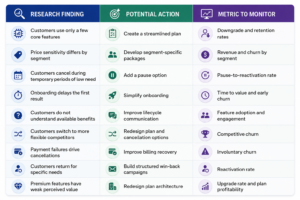
Not every finding requires a product redesign. Sometimes the solution is clearer communication, better onboarding or a more relevant renewal message.
Build Flexibility Without Training Customers to Wait for Discounts
Discounting is often the fastest response to rising cancellations, but frequent discounts can damage price credibility.
Customers may learn to cancel and wait for a lower offer. Existing loyal subscribers may also feel penalised for continuing to pay the standard price.
Research can identify more sustainable alternatives, including:
- Temporary pauses
- Lower-usage plans
- Feature-based tiers
- Annual commitment incentives
- Usage-based pricing
- Bundled options
- Add-on services
- Loyalty rewards
- Personalised win-back offers
- Ad-supported or limited-access versions
The correct option depends on why customers are leaving. A pause can help customers with temporary needs, while a smaller plan may suit customers who consistently use only part of the service.
Subscription Fatigue Varies by Industry
The causes of fatigue differ across subscription models.
Software and B2B Services
Businesses may cancel because of low user adoption, overlapping tools, unused licences, difficult integrations or a failure to demonstrate return on investment.
Research should include users, budget holders, procurement teams and decision-makers because each group may evaluate value differently.
Media and Entertainment
Customers may cycle between services according to content availability, release schedules and price. Bundling, ad-supported plans and easy reactivation may be particularly relevant.
Retail and Subscription Boxes
Customers may experience product accumulation, reduced novelty or limited control over delivery frequency. Preference research can identify suitable options for personalisation, skipping deliveries or changing quantities.
Wellness and Membership Services
Usage patterns, location, personal motivation and perceived progress can strongly influence retention. Journey research should examine whether customers are achieving the outcome promised during acquisition.
Education and Professional Learning
Customers may disengage because the content becomes irrelevant, progress is difficult to measure or completion requires more time than expected. Research should investigate learning outcomes, format preferences and barriers to continued participation.
Metrics Businesses Should Track
Research recommendations should be evaluated against clearly defined retention and revenue metrics.
Important measures include:
- Voluntary churn rate
- Involuntary churn rate
- Renewal rate
- Downgrade rate
- Pause rate
- Reactivation rate
- Customer lifetime value
- Monthly recurring revenue
- Average revenue per user
- Feature adoption
- Time to first meaningful value
- Customer acquisition cost
- Net revenue retention
- Cancellation reasons by segment
- Customer satisfaction across the subscription journey
Businesses should monitor these metrics by customer segment rather than relying only on company-wide averages. An overall churn rate can remain stable while a commercially important segment deteriorates.
Why Subscription Research Should Be Continuous
Subscription behaviour changes as prices, competitors, customer expectations and economic conditions change.
A single research project can solve an immediate problem, but ongoing tracking helps businesses identify changes before they become visible in revenue results.
A practical programme may combine:
- Continuous cancellation feedback
- Quarterly subscriber pulse surveys
- Periodic pricing studies
- Customer journey reviews
- Competitor monitoring
- Usage and cohort analysis
- Interviews with churned and reactivated customers
Continuous research is particularly important for businesses serving several customer segments or operating across multiple markets.
How HBG Knowledge Supports Subscription Businesses
HBG Knowledge helps subscription businesses investigate the reasons behind customer disengagement and convert those findings into practical decisions.
Depending on the research objective, the approach may combine:
- Online surveys
- Qualitative interviews
- Expert consultations
- Customer preference analysis
- Pricing research
- Competitive intelligence
- Customer journey research
- CATI and phone-to-web data collection
- Data analysis and reporting
HBG’s documented research capabilities include in-house sampling and panel-management teams, validated online panels, expert interviews, CATI, phone-to-web research, survey programming, analysis and reporting. HBG can also combine primary research with secondary market analysis to provide a more complete view of customer needs and competitive conditions.
Rather than assuming subscription fatigue is only a pricing problem, the research process examines the complete relationship between customer expectations, product usage, perceived value and market alternatives.
The result is a clearer answer to three critical questions:
- Why are customers leaving?
- Which customers are most at risk?
- Which changes are most likely to improve retention without damaging long-term value?
Turn Subscription Fatigue Into a Retention Opportunity
Customers do not necessarily cancel because they have stopped needing a product or service. They may need more flexibility, a clearer value proposition or a plan better suited to how they use it.
HBG Knowledge can help identify the factors influencing cancellation, test pricing and plan alternatives, analyse customer preferences and benchmark competing subscription models.
Request a customised subscription research consultation to understand what is driving churn and where your strongest retention opportunities lie.
Frequently Asked Questions
What is subscription fatigue?
Subscription fatigue is a growing reluctance to maintain recurring payments because customers feel they have too many subscriptions, prices have increased or the services no longer provide sufficient value.
How can market research help reduce subscription fatigue?
Market research identifies why customers disengage and which actions are most likely to improve retention. It may examine price sensitivity, product usage, customer experience, competitor switching and changing customer needs.
Is subscription fatigue always caused by high prices?
No. Customers may cancel because they do not use the product enough, experience onboarding or billing problems, find a better alternative or no longer need the service. Pricing research should be combined with behavioural and customer experience analysis.
Which research methods are most useful for subscription businesses?
Useful methods include cancellation surveys, in-depth interviews, cohort analysis, customer journey research, MaxDiff analysis, conjoint analysis, Gabor-Granger testing and competitive intelligence.
What is the difference between voluntary and involuntary churn?
Voluntary churn occurs when a customer actively cancels. Involuntary churn usually results from payment failures, expired payment information or other billing issues.
Can a pause option reduce subscription cancellations?
A pause option can help customers whose need is temporary or seasonal. It allows them to remain connected to the service rather than ending the relationship completely. Its effectiveness should be measured through pause, reactivation and eventual cancellation rates.
How often should subscription businesses conduct customer research?
Cancellation feedback and behavioural monitoring should be continuous. Broader subscriber surveys, pricing studies and competitive reviews can be conducted periodically depending on changes in customer behaviour, product strategy and market conditions.
How does competitive intelligence support subscriber retention?
Competitive intelligence reveals how other businesses structure prices, plans, bundles, trials, cancellation options and retention offers. This helps identify weaknesses in the current subscription model and opportunities competitors have not addressed.
What makes HBG Knowledge’s research approach different?
HBG Knowledge combines quantitative and qualitative research methods with in-house sampling capabilities, customer research, expert interviews, competitive intelligence, analysis and reporting. This enables businesses to examine subscription fatigue from multiple perspectives rather than relying on a single data source.