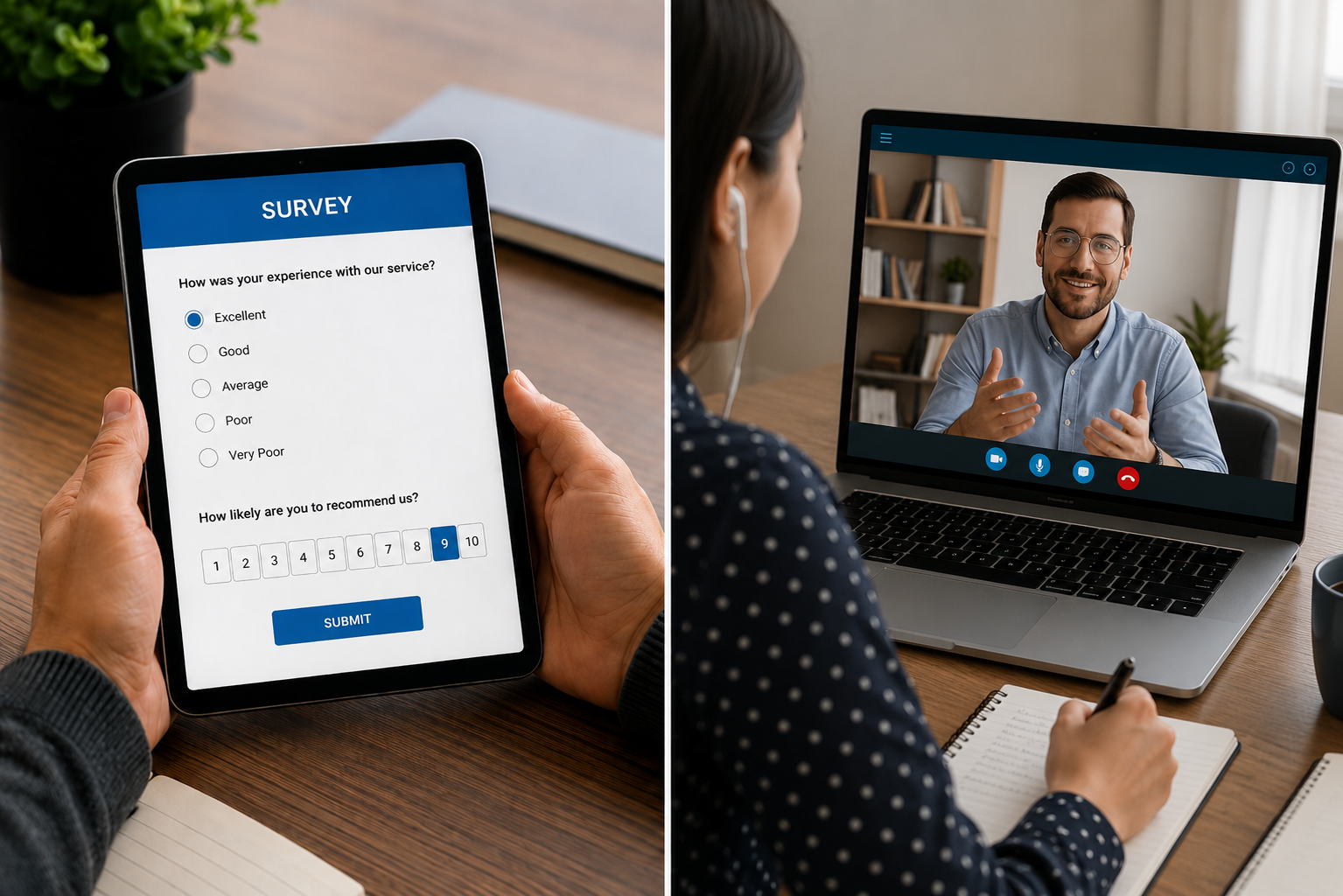
Surveys vs Interviews in Market Research: Which Method Should You Use?
Use surveys when you need to measure patterns across a large audience. Use in-depth interviews when you need to understand the motivations, experiences, and context behind those patterns. Use both when the decision requires statistical confidence as well as a clear explanation of what is driving the results.
That sounds straightforward, but choosing between surveys and interviews is where many research projects begin to drift.
A survey may show that 62% of customers are dissatisfied with a product’s pricing. What it cannot tell you on its own is whether the price feels unfair, the value proposition is unclear, or a competitor has recently changed what customers consider reasonable.
An interview can uncover those explanations. However, speaking to 15 customers cannot prove that the same view is shared across the wider market.
This is the real difference between surveys and interviews in market research. One measures the scale of an issue. The other helps explain it.
Understanding where each method works best directly affects the quality of the evidence, the confidence placed in the findings, and the amount of time and budget spent reaching the wrong conclusion.
What Are Surveys Built to Deliver?
A survey is designed to collect structured responses from a defined audience.
Every participant is asked the same core questions, usually in the same order. This consistency allows researchers to count responses, compare audience groups, identify patterns, and track changes over time.
Surveys work best when the research question includes phrases such as:
- How many?
- How often?
- What percentage?
- Which option is preferred?
- Has customer sentiment changed?
- How does one market compare with another?
For example, a company launching a new B2B service may need to know how many decision-makers recognize the problem, how satisfied they are with current solutions, and what percentage would consider switching providers.
A well-designed B2B market research survey can answer those questions across industries, job roles, company sizes, and geographic markets.
Where Surveys Perform Best
Online surveys are particularly useful for:
- Measuring customer satisfaction and brand perception
- Tracking changes in customer attitudes over time
- Comparing audience segments or geographic markets
- Estimating demand for a product or service
- Testing pricing, messaging, or product features
- Benchmarking performance against previous research
- Running multi-country consumer or B2B research
- Producing quantitative evidence for internal decision-making
Their biggest advantage is scale. A structured survey can reach hundreds or thousands of respondents much more efficiently than individual interviews.
However, a large sample does not automatically mean reliable research.
The quality of the results depends on the sampling method, respondent verification, questionnaire design, survey length, data cleaning, and whether the people completing the survey genuinely match the target audience.
A badly designed survey can generate very precise-looking numbers that answer the wrong question.
What Are In-Depth Interviews Built to Deliver?
An in-depth interview, commonly called an IDI, is a one-to-one conversation between a trained researcher and a participant.
Unlike a fixed survey, an interview is adaptive. The researcher can ask follow-up questions, explore contradictions, clarify vague answers, and investigate topics that were not anticipated during the original research design.
The value of an IDI market research interview is not simply that the respondent speaks for longer. The value comes from the researcher knowing what to explore, when to challenge an assumption, and when to let the participant take the conversation in an unexpected direction.
Interviews work best when the research question includes phrases such as:
- Why did this happen?
- How was the decision made?
- What influenced the choice?
- What concerns were not openly discussed?
- How do customers describe the problem in their own words?
- Why does the survey data appear contradictory?
Where Interviews Perform Best
In-depth interviews are particularly useful for:
- Understanding the reasoning behind a purchase decision
- Exploring complex B2B buying journeys
- Testing an early-stage product or service concept
- Investigating sensitive or emotionally complex subjects
- Speaking with senior executives, specialists, or hard-to-reach respondents
- Understanding why customers switch providers
- Exploring unexpected survey findings
- Identifying language for future questionnaires or marketing communication
Interviews provide detail, context, and nuance. What they do not provide is statistical representation.
Speaking to 10, 20, or 30 people can reveal important themes, but it does not prove that those themes apply to the entire market. The appropriate number of interviews depends on the complexity of the topic, the diversity of the audience, and whether new conversations are still producing meaningfully different insights.
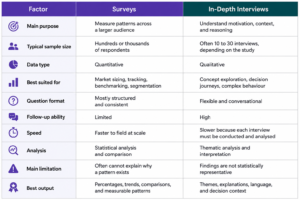
Surveys vs Interviews: Side-by-Side Comparison
Should You Use Surveys, Interviews, or Both?
The right method depends on the decision the research needs to support.
Choose Surveys When You Need Scale
Use online surveys when the business needs to measure how widely a view, behaviour, or preference is shared.
A survey is usually the better option when:
- The target audience is clearly defined
- The business needs percentages or measurable benchmarks
- Results must be compared across audience segments
- The research will be repeated over time
- The findings need to support market sizing or forecasting
- Leadership requires quantitative evidence
Choose Interviews When You Need Depth
Use in-depth interviews when the business needs to understand a decision, experience, or problem in greater detail.
Interviews are usually the better option when:
- The topic is complex or poorly understood
- The audience is highly specialised
- The research concerns a sensitive issue
- The business needs to explore a buying journey
- A product concept is still being developed
- Existing survey results raise more questions than answers
Choose Both When the Decision Requires Confidence and Context
Many important research questions cannot be answered properly with one method alone.
A mixed-method market research project may begin with interviews to identify important themes, customer language, or decision criteria. Those findings can then be converted into a structured survey and tested across a larger audience.
The process can also work in reverse. A survey may identify an unexpected trend, followed by targeted interviews that explore what is causing it.
A practical mixed-method sequence might look like this:
- Conduct interviews to explore the problem.
- Identify recurring themes and possible explanations.
- Build a survey that measures how widely those themes apply.
- Analyse differences across customer or market segments.
- Return to selected respondents for deeper follow-up where required.
This approach combines the exploratory strength of qualitative research with the measurable confidence of quantitative research.
The Mistake Many Businesses Make
The most common mistake is not choosing the wrong method completely. It is expecting one method to answer every part of the problem.
A business that relies only on surveys may end up with clean charts and unexplained customer behaviour.
A business that relies only on interviews may end up with persuasive stories from a small number of respondents that do not reflect the broader market.
Both situations can create false confidence.
The question should not be, “Which method is better?”
The better question is, “What evidence do we need before we can make this decision responsibly?”
Online Survey Platform vs Online Survey Company
These terms are often used interchangeably, but they describe different services.
An online survey platform is primarily software. It allows users to create questionnaires, distribute links, collect responses, and view basic results.
An online survey company may provide a much broader research service, including:
- Research design
- Questionnaire development
- Respondent recruitment
- Consumer or B2B panel access
- Survey programming
- Translation and localisation
- Data-quality checks
- Statistical analysis
- Insight development
- Reporting and recommendations
A full-service market research company may also offer qualitative methods such as in-depth interviews, focus groups, expert consultations, and ethnographic research.
This distinction matters when comparing top online survey platforms with online survey companies.
A platform may be sufficient for a simple employee poll or customer feedback form. A research partner is more appropriate when sampling quality, respondent verification, multi-market consistency, or strategic interpretation will affect the business decision.
What Separates Strong Online Survey Companies from the Rest?
Not every survey provider delivers the same standard of evidence.
Whether a business is comparing online survey companies, looking for a global online survey company, or evaluating the best online survey company in the UK, the selection should go beyond questionnaire software and quoted cost per response.
Strong research partners usually demonstrate the following capabilities.
Verified Respondent Recruitment
The provider should explain where respondents come from, how identities are checked, how professional profiles are validated, and how duplicate or fraudulent participation is prevented.
This becomes especially important in B2B research, where job titles, purchasing authority, company size, and industry experience may determine whether a respondent qualifies.
Clear Quality-Control Processes
Reliable research requires more than removing people who complete a survey too quickly.
Quality checks may include attention tests, consistency checks, duplicate detection, open-text review, device analysis, response-pattern analysis, and manual data inspection.
Genuine Geographic Coverage
A provider claiming global reach should be able to explain how research is managed consistently across markets.
That includes respondent availability, local language support, cultural adaptation, sampling consistency, and comparable quality standards.
Methodological Flexibility
The strongest research companies do not force every business question into a survey.
They can recommend interviews, expert consultations, focus groups, or mixed-method research when those approaches are better suited to the decision.
Insight, Not Just Data Delivery
A spreadsheet is not a research outcome.
A capable research partner should help the client understand what the findings mean, where the evidence is strong, what limitations should be considered, and which decisions the data can realistically support.
How HBG Knowledge Combines Surveys and Interviews
HBG Knowledge supports both quantitative and qualitative market research through a coordinated research process.
Online surveys can be used to reach consumer and B2B audiences, measure market patterns, compare respondent groups, and build evidence that can be tracked over time.
In-depth interviews and expert consultations add another layer. They allow researchers to explore how customers, professionals, and decision-makers think about a problem, what influences their choices, and why certain behaviours appear in the quantitative results.
Rather than treating surveys and interviews as disconnected services, HBG can design research that moves between the two.
A project may begin with interviews to understand the market and develop stronger survey questions. It may begin with an online survey and use follow-up interviews to investigate unexpected findings. In other cases, both methods may run together, with each answering a different part of the business question.
This approach can support research across sectors such as Healthcare, Automotive, Financial Services, Consumer Goods, Retail, Technology, and Energy.
The goal is not simply to collect more information. It is to build a clear line between the research question, the evidence gathered, and the decision the client needs to make.
Frequently Asked Questions
What is the main difference between surveys and interviews in market research?
Surveys collect structured answers from a larger group of respondents, making it possible to measure and compare patterns. In-depth interviews explore the reasoning, context, and experiences behind those patterns. Surveys provide scale, while interviews provide depth.
Are surveys quantitative or qualitative?
Surveys are generally used as a quantitative research method because they produce structured data that can be counted and statistically analysed. However, surveys may also include open-ended questions that generate limited qualitative feedback.
Are in-depth interviews statistically representative?
No. In-depth interviews are not designed to statistically represent an entire market. Their purpose is to explore experiences, language, motivation, and context in greater detail.
When should a business use interviews before a survey?
Interviews should be used first when the topic is not well understood, the questionnaire themes are unclear, or the business needs to learn how customers naturally describe the problem. Interview findings can then be used to design a more relevant survey.
When should interviews be conducted after a survey?
Follow-up interviews are useful when survey results are unexpected, contradictory, or difficult to explain. Researchers can speak with selected respondents to explore what may be driving the pattern.
Can surveys and interviews be used in the same research project?
Yes. This is known as mixed-method research. Surveys can measure how widely a pattern applies, while interviews help explain why that pattern exists. Combining both methods often produces more useful and defensible insights.
What should I look for in a global online survey company?
Look for transparent respondent sourcing, reliable quality controls, multi-country fieldwork capability, B2B and consumer recruitment expertise, clear sampling processes, and the ability to analyse and interpret the results.
What is the difference between an online survey platform and an online survey company?
An online survey platform provides software for creating and distributing questionnaires. An online survey company may also design the research, recruit respondents, programme the survey, manage fieldwork, clean the data, analyse findings, and provide recommendations.
How does HBG Knowledge support survey and interview research?
HBG Knowledge supports online surveys, B2B market research surveys, in-depth interviews, and expert consultations. These methods can be used independently or combined within a single research programme, depending on the business question and the evidence required.
Conclusion
Surveys and interviews are not competing research methods. They solve different parts of the same problem.
Surveys show how widely a pattern appears across a market. Interviews help explain the experiences, reasoning, and context behind that pattern.
The strongest research design is not necessarily the one with the largest sample or the longest interview schedule. It is the one that matches the method to the decision.
When scale is required, use surveys. When explanation is required, use interviews. When the decision carries real commercial weight, using both may provide the clearest view.
Not sure whether your research needs scale, depth, or a combination of both? Speak with an HBG Knowledge research specialist to choose the right methodology, audience, and fieldwork approach.