
Manufacturers Are Finally Asking Customers What They Want – Here’s Why That’s New
For decades, manufacturing ran on a simple internal logic: engineers designed, production optimized, and sales sold what the factory built. Customer input, if it existed at all, arrived after the product had already shipped.
That model is breaking down. A growing number of industrial companies now treat manufacturing market research as a core input to product strategy, not an afterthought. They are asking buyers, distributors, and technical decision-makers what they actually need – before committing capital to a design.
This shift is not cosmetic. It reflects a deeper change in how competitive advantage is built in industrial markets, and it explains why customer research for manufacturers has moved from “nice to have” to boardroom priority.
Why This Shift Is Happening Now
Several forces are pushing manufacturers to formalize how they listen to customers.
Rising customer expectations. Buyers now compare industrial suppliers the way consumers compare retail brands – on experience, responsiveness, and fit, not just price and specs.
Faster innovation cycles. Product lifecycles have compressed. Companies that wait for market feedback after launch lose ground to competitors who validate ideas earlier.
Intensifying competition. New entrants, private-label manufacturers, and global suppliers have narrowed the room for error. A misjudged product launch is costlier than ever.
Global supply chain disruption. Sourcing shifts and regional realignment have forced manufacturers to rethink which markets and buyer segments they serve – decisions that require direct industrial buyer insights, not internal guesswork.
Digital transformation. Data infrastructure now makes it feasible to run structured, multi-market research programs that would have been logistically difficult a decade ago.
Demand for personalization. Even in B2B and industrial contexts, buyers increasingly expect configurable products and tailored solutions, which requires understanding segment-specific needs.
Together, these forces make one thing clear: internal assumptions, however experienced the team, are no longer a reliable substitute for direct customer input.
What Customer Research Means in Modern Manufacturing
B2B market research services in manufacturing look different from consumer research. The “customer” is rarely one person – it’s a buying committee that includes procurement, engineering, plant operations, and executive sponsors.
Effective programs gather input from across this ecosystem:
- Existing customers, to understand satisfaction and unmet needs
- Prospective buyers, to test demand before launch
- Dealers and distributors, who see market shifts firsthand
- Procurement teams, who control purchasing criteria
- Engineers and technical decision-makers, who evaluate specifications
- Channel partners, who influence adoption at scale
Manufacturers typically combine two research approaches:
Qualitative research – in-depth interviews and focus groups that uncover the “why” behind a decision, surface unspoken pain points, and test early concepts.
Quantitative research – structured surveys across larger samples that validate findings, size opportunities, and support go/no-go decisions with statistical confidence.
Used together, these methods form a foundation for industrial market research that is both deep and defensible.
How Customer Insights Improve Manufacturing Decisions
When customer research is embedded early, it changes outcomes across the product lifecycle.
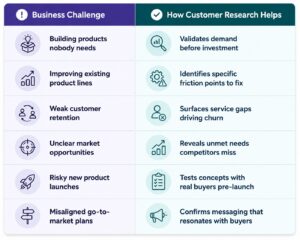
For example, a component manufacturer considering a new mounting system can run interviews with plant engineers to learn whether installation time – not price – is the real barrier to adoption. That single insight can reshape a product roadmap.
This is the practical value of B2B customer research: it replaces internal debate with evidence.
Why Many Manufacturers Still Miss the Voice of the Customer
Despite growing awareness, many manufacturers still fall short. Common patterns include:
- Product and pricing decisions made on assumptions, not evidence
- Customer engagement limited to sales calls, which capture opinion but not structured insight
- Feedback collected only after launch, when changes are expensive
- Research conducted with the wrong participants or poor-quality samples
- Voice-of-customer efforts siloed within sales rather than shared across the business
The consequences are measurable: delayed launches, products that require costly rework, and lost share to competitors who validated demand first. This is precisely the gap that structured voice of customer programs are designed to close.
What an Effective Manufacturing Customer Research Program Looks Like
A reliable program shares a few defining characteristics:
- Clear objectives. Every study answers a specific business question, not a general curiosity.
- The right participants. Recruiting verified B2B and technical buyers, not convenience samples.
- Mixed methodology. Pairing qualitative depth with quantitative validation.
- Global reach. Insights gathered across the markets a manufacturer actually serves.
- Continuity. Voice-of-customer research run as an ongoing program, not a one-time project.
- Actionability. Findings translated into decisions – product specs, pricing, positioning -not just reports.
Manufacturers that build research into their operating rhythm consistently make faster, better-supported decisions than those treating it as a occasional exercise.
How HBG Knowledge Helps Manufacturers Capture Reliable Customer Insights
Running research that spans multiple countries, technical buyer types, and methodologies is difficult to do well in-house. HBG Knowledge helps manufacturers close that gap.
The team supports manufacturers with global qualitative research, quantitative surveys, in-depth interviews (IDIs), and focus group discussions (FGDs) designed specifically for industrial and technical audiences.
This includes recruiting verified B2B participants – engineers, procurement leads, and other decision-makers who are difficult to reach through standard panels – and collecting data across global markets to support multi-region product and expansion decisions.
The result is B2B manufacturing insights manufacturers can act on with confidence, not raw data that still needs interpretation.
Why Manufacturers Partner with HBG Knowledge
Manufacturers choose HBG Knowledge for a combination of reach, expertise, and reliability:
- Global respondent access across industrial sectors
- Deep familiarity with B2B and manufacturing research design
- Verified, hard-to-reach technical and procurement participants
- Multi-country research execution
- Rigorous qualitative and quantitative methodologies
- Consistently high-quality, clean data
- Efficient project timelines
- Insights structured for strategic decision-making, not just reporting
Conclusion
Customer-centric manufacturing is no longer optional. Manufacturers who consistently gather and act on customer insight are better positioned to innovate with confidence, refine products that matter, and build lasting buyer relationships. Structured manufacturing market research has become a genuine competitive advantage – not a courtesy extended to customers, but a discipline that protects revenue and accelerates growth.
Turning Insight Into Action
If your product, pricing, or go-to-market decisions still rest mainly on internal assumptions, it may be time to bring structured customer evidence into the process. HBG Knowledge helps manufacturers gather that evidence reliably, across markets and buyer types, so decisions are backed by real voice-of-customer data rather than guesswork.
Partner with HBG Knowledge
Ready to make product and market decisions backed by real customer insight?
Partner with HBG Knowledge for reliable manufacturing market research that supports smarter product development, stronger customer experiences, and more confident business decisions. Contact HBG Knowledge today to discuss your research goals.
FAQs
- What is manufacturing market research?
It is the structured process of gathering feedback from customers, distributors, and technical buyers to inform product, pricing, and market decisions in industrial and manufacturing businesses. - Why is customer research important for manufacturers?
It reduces the risk of costly product failures by validating demand and design decisions with real buyer input before launch. - What methods are used in industrial market research?
Common methods include in-depth interviews, focus group discussions, and quantitative surveys, often combined for depth and statistical validation. - Who should manufacturers survey for product feedback?
Existing customers, prospective buyers, dealers, distributors, procurement teams, and technical decision-makers all provide valuable, distinct perspectives. - How does HBG Knowledge support global manufacturers?
By providing multi-country qualitative and quantitative research with verified B2B participants across industrial sectors.