
Recruiting Hard-to-Reach B2B Decision-Makers: What Actually Works in 2026
Key Takeaways
- A senior job title does not automatically prove relevant experience or decision-making authority.
- Effective B2B recruitment begins with a precise participant profile covering function, seniority, company characteristics, category experience, and purchasing involvement.
- Proprietary panels, direct sourcing, telephone recruitment, expert networks, and carefully selected partner panels can all contribute to the final sample.
- Identity verification should combine professional-profile checks, workplace validation, phone screening, and survey-quality controls.
- Recruitment feasibility depends on incidence rate, role scarcity, geography, interview length, incentives, and the sensitivity of the research topic.
- HBG Knowledge uses proprietary B2B respondent access, managed sample, online surveys, CATI, and expert consultations to support complex research assignments.
- Published HBG case studies demonstrate how precise screening and phone validation have been applied to recruit business leaders, technical specialists, and senior decision-makers.
B2B decision-maker recruitment is one of the most challenging parts of B2B market research. Senior B2B decision-makers are valuable participants, but they are also among the most difficult professionals to recruit and validate correctly.
Their time is limited, their contact details are heavily targeted, and their responsibilities are often more complex than their job titles suggest. A vice president may approve a purchase without evaluating the product. A procurement leader may negotiate a contract without selecting the supplier. A technical specialist may influence the decision without controlling the budget.
Business buying decisions are also increasingly distributed. Forrester reports that a typical buying decision involves 13 internal stakeholders and nine external influencers, with participation increasing for more complex or strategic purchases.
The challenge is therefore not simply reaching someone senior. It is identifying the person whose experience and authority match the exact research question.
What Makes B2B Decision-Maker Recruitment Difficult?
Effective B2B decision-maker recruitment starts with a precise eligibility matrix.
Recruitment difficulty normally increases when a study requires several qualifications simultaneously, such as the following:
- Employment within a specific industry
- A director-level or executive position
- Responsibility for a particular function
- Employment at a company above a defined size or revenue level
- Recent involvement in a purchase or implementation
- Authority to recommend, evaluate or approve suppliers
- Knowledge of budgets, operational performance or strategic plans
- Location within a specific market
- No conflicts involving competitors, vendors or consulting firms
As a result, each additional requirement reduces the number of eligible participants.
For example, recruiting general IT managers may be relatively achievable. Recruiting enterprise cybersecurity leaders at companies with more than 5,000 employees who approved a platform purchase during the past 12 months is significantly more difficult.
This is why B2B participant recruitment must begin with feasibility rather than an arbitrary sample target.
A Decision-Maker Is Not a Single Persona
Different members of a buying committee contribute different types of insight.
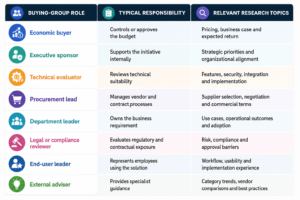
A study about software usability should not recruit only chief information officers. A study about purchasing authority should not rely solely on end users.
The target participant must be selected according to the decision being investigated.
Start With a Precise Eligibility Matrix
Broad descriptions such as “technology decision-makers” or “senior healthcare professionals” are not sufficient for dependable recruitment.
Effective B2B decision-maker recruitment starts with a precise eligibility matrix.
Company characteristics
- Industry
- Employee count
- Annual revenue
- Ownership type
- Operating markets
- Business model
Participant characteristics
- Current role
- Department
- Seniority
- Years of experience
- Reporting responsibility
Decision involvement
- Identifies the need
- Recommends potential suppliers
- Evaluates products
- Conducts technical testing
- Negotiates pricing
- Approves budget
- Signs the final contract
- Oversees implementation
Relevant experience
- Product or service category
- Vendors considered
- Purchase date
- Implementation status
- Budget range
- Technology or methodology used
Exclusion criteria
- Employment by a direct competitor
- Consulting relationships that could create bias
- Insufficient recency
- No direct participation in the decision
- Previous participation in a conflicting study
A stronger qualification criterion might state:
The participant must currently lead enterprise cybersecurity operations at a US organization with more than 1,000 employees and must have directly evaluated, recommended, or approved a cybersecurity-platform purchase within the past 18 months.
That is more defensible than qualifying every respondent with “security” in their job title.
Use the Right Combination of Recruitment Sources
B2B decision-maker recruitment often requires multiple sourcing methods.
A modern recruitment strategy may combine proprietary panels, direct professional sourcing, telephone outreach, expert networks, referrals, and external panel partners.
Proprietary B2B panels
First, a proprietary panel can provide faster access to professionals whose identities, participation history, and profile information are already available.
HBG Knowledge states that its services are supported by a proprietary database containing more than 10 million B2B respondents. Its service page also says survey specialists validate records using internal information and professional data sources such as LinkedIn, D&B, and ZoomInfo.
However, a large database alone does not guarantee relevance. The value depends on:
- Profile accuracy
- Frequency of profile updates
- Validation methods
- Previous participation
- Available targeting fields
- Duplicate controls
- Respondent engagement
Direct professional sourcing
Similarly, direct sourcing is useful when a study requires…named organizations, unusual roles, or highly specialized professionals.
Potential sources include the following:
- Corporate leadership pages
- Professional associations
- Conference speaker lists
- Industry directories
- Professional networking platforms
- Specialist publications
- Regulatory or certification databases
Therefore, each sourced participant must still be screened and validated.
Telephone recruitment
In addition, telephone outreach can be particularly useful for explaining a complex study, confirming professional experience and assessing whether the participant genuinely understands the subject.
HBG’s recruitment-related careers information describes roles involving cold calling, pitching, screening, networking, and building relationships with industry experts. It also references CATI and computer-assisted web interviews as part of the company’s research operations.
Expert networks
Meanwhile, expert networks are most appropriate when the research requires depth from a small number of highly qualified professionals.
HBG’s expert-insight process publicly includes the following:
- Requirement review
- Search within the expert network
- Profile sharing for client review
- Phone screening and validation
- Consultation scheduling
The company offers telephone, video, and in-person consultations, as well as focus groups, bulletin boards, events, and short-term expert projects.
Certified panel partners
However, not every audience will be available through an owned panel.
HBG’s online-survey page states that it combines proprietary panels with access to premium online panels through certified local partners. This is an important distinction: HBG does not publicly position every respondent as being recruited exclusively through an internal database.
Using a partner panel is not automatically a quality problem. The provider must disclose the source, validation process, and quality controls applied to partner-supplied participants.
What Effective Outreach Looks Like
However, generic invitations underperform because they fail to establish relevance and credibility.
A strong invitation should explain the following:
- Who is conducting the research
- Why the individual appears relevant
- What the discussion or survey covers
- How long participation will take
- Whether an incentive is provided
- How responses and personal information will be handled
- What the participant must do next
Example Recruitment Invitation
Subject: Research interview on enterprise software implementation
Hello [Name],
We are conducting a confidential research study with senior professionals who have recently helped evaluate or implement enterprise process-management software.
Your experience as [role] at [company] appears relevant to the study. The discussion would take approximately 30 minutes and would focus on evaluation criteria, implementation responsibilities, and operational challenges. We would not request confidential company information.
Qualified participants will receive [incentive] as compensation for their time.
Would you be open to completing a brief eligibility check?
Regards,
[Recruiter name]
[Company and verified contact details]
The message is concise, transparent, and specific to the participant’s professional background.
Screen for Actual Decision-Making Experience
A self-declared title should not be the final qualification criterion.
Weak screening asks:
Are you involved in software purchasing?
A stronger screener tests the participant’s actual experience:
- Which stages of the purchase process did you participate in?
- When did your organization most recently evaluate this category?
- Which vendors were considered?
- What evaluation criteria were used?
- Who controlled the final budget?
- Did you recommend, test, negotiate, or approve the solution?
- Which implementation activities were under your responsibility?
- What was the approximate company or project size?
In addition, answers should be compared for consistency.
For example, a participant claiming final purchasing authority should be able to describe the approval process, evaluation stages, and other stakeholders involved.
Apply Layered Verification and Validation
A layered verification process strengthens B2B decision-maker recruitment.
A stronger process combines several layers.
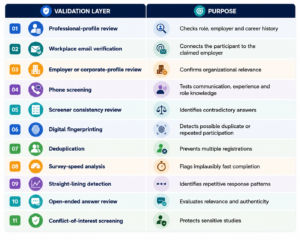
ESOMAR’s online sample-quality guidance identifies participant validation, fraud prevention, engagement checks, exclusions, and transparency in sample selection as core quality requirements.
HBG’s online-panel documentation states that panel members are recruited by invitation rather than open self-selection. It also describes workplace email, social media, and telephone checks; automated screening for multiple registrations; and requests for members to refresh their information every six months.
HBG’s published ESOMAR response further references phone-based validation, physical-address checks where possible, internal deduplication, digital fingerprinting, and removal of respondents who provide conflicting answers. It also recommends completion-time analysis, outlier detection, straight-lining controls, speeding checks, and red-herring questions.
Match the Research Method to the Audience
The right methodology also supports effective B2B decision-maker recruitment.
Online surveys
Online surveys are appropriate when the objective is to quantify patterns across a larger B2B sample.
They can measure:
- Vendor awareness
- Product usage
- Purchase criteria
- Budget expectations
- Brand consideration
- Technology adoption
- Satisfaction
- Future investment
HBG states that it supports sample-only studies, multicountry projects, tracking research, product testing, incidence checks, and mobile surveys across more than 100 countries.
CATI
Computer-assisted telephone interviewing is useful when:
- Participants are difficult to engage through survey links
- Questions require explanation
- Role validation is important
- The subject is technical
- Researchers need controlled probing
- The available respondent universe is small
CATI can combine structured questions with interviewer-led clarification while maintaining consistency across the study.
In-depth interviews
IDIs are appropriate when the research needs detailed understanding of the following:
- Buying processes
- Strategic priorities
- Implementation challenges
- Vendor evaluation
- Internal stakeholder dynamics
- Market trends
- Technical requirements
Expert consultations
Expert consultations are useful when a small number of highly qualified professionals can provide more decision-relevant depth than a broad general sample.
They may support:
- Market and opportunity assessments
- Industry best-practice research
- Strategy formulation
- Product validation
- Due diligence
- Market-entry decisions
- Regulatory understanding
Focus groups and bulletin boards
These methods allow several professionals to discuss a topic and react to each other’s perspectives.
They require careful handling when participants work for competing organizations or when the subject involves confidential commercial information.
Plan Incentives According to Recruitment Difficulty
Incentives should reflect:
- Participant seniority
- Audience scarcity
- Study length
- Preparation requirements
- Topic sensitivity
- Geographic market
- Scheduling restrictions
- Qualitative or quantitative format
An incentive that is too low may fail to compensate a senior participant for their time. An incentive that is excessively high may encourage applicants to exaggerate their qualifications.
Researchers should disclose incentive conditions before participation, including:
- Payment amount
- Qualification requirements
- Payment method
- Payment timeline
- Treatment of partial participation
- Rescheduling or cancellation conditions
Research teams should manage incentive records separately from research responses wherever practical.
Assess Recruitment Feasibility Before Fieldwork
Researchers should estimate recruitment difficulty before finalizing the sample size and timeline.
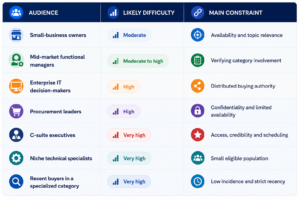
The feasibility assessment should consider:
- Estimated eligible population
- Expected qualification rate
- Geographic restrictions
- Required seniority
- Company-size requirements
- Purchase-recency window
- Interview duration
- Incentive
- Conflict exclusions
- Required fieldwork period
Researchers should not loosen the criteria merely to fill the quota without client approval.
Fast Recruitment Does Not Mean Instant Recruitment
HBG’s expert-insight page promotes expert onboarding within 24–48 hours after receiving a suitable requirement. However, its published case studies show that completing more complex, multi-participant recruitment assignments can require several weeks.
This distinction matters.
A first qualified profile may be available quickly, while completing an entire sample requires time for the following:
- Sourcing
- Screening
- Client approval
- Scheduling
- Reminders
- Interviews
- Replacements
- Quality checks
Recruitment timelines should therefore be based on the complete project scope rather than the speed of presenting the first candidate.
Protect Participant Privacy and Confidentiality
B2B participant information may include:
- Name
- Employer
- Job title
- Corporate email
- Telephone number
- Professional experience
- Study-participation history
- Incentive details
- Survey or interview responses
HBG’s privacy policy states that the company may act as either a data processor or data controller, depending on the research arrangement. It also states that participant information may be retained for future panels or repeat studies after consent has been obtained. The policy references GDPR, India’s Digital Personal Data Protection Act, and the California Consumer Privacy Act among the relevant data-protection frameworks.
A responsible recruitment process should clarify the following:
- Why information is collected
- How it will be used
- Who will receive it
- How long it will be retained
- Whether the participant may be contacted again
- How opt-out and deletion requests are managed
- Whether identifiable information is shared with the research client
- How confidential business information will be protected
Publicly available professional information should not be treated as unrestricted permission for indefinite storage or repeated outreach.
Monitor Quality Throughout Fieldwork
Therefore, research teams should review recruitment quality while the study is active, not only after data collection closes.
A fieldwork dashboard should track:
- Contacts attempted
- Responses by recruitment source
- Screener starts
- Qualification rate
- Incidence rate
- Scheduled interviews
- Attendance rate
- Survey completions
- Dropout rate
- Quality rejections
- Duplicate attempts
- Quota progress
- Average recruitment time
- Incentive cost per qualified completion
- Opt-outs
The performance of each source should be reviewed separately.
For example, a source that provides inexpensive completions may still be poor value if it also produces higher fraud, contradiction, or rejection rates.
What HBG Knowledge’s Published Recruitment Process Shows
HBG Knowledge public website positions the company as a global market research and data-collection firm offering custom research, market sizing, customer insights, forecasting, and consulting support. Its sector coverage includes healthcare, technology, financial services, manufacturing, media and telecom, retail, energy, professional services, automotive, and consumer products.
HBG Knowledge Recruitment Capabilities
Its documented recruitment and fieldwork capabilities include the following:
- A proprietary database of more than 10 million B2B respondents
- Proprietary online panels
- Certified local panel partners
- Managed sample services
- Direct professional sourcing
- Workplace-email verification
- Professional and social-profile checks
- Telephone validation
- Digital fingerprinting and deduplication
- CATI and phone-to-web recruitment
- Expert interviews
- One-to-one and video consultations
- Focus groups and bulletin boards
- Survey programming
- Data analysis and reporting
- Support across more than 30 languages through its internal team
This is a stronger and more accurate positioning than claiming that every participant comes exclusively from one internal source.
Recruitment Examples From HBG Knowledge
HBG Knowledge’s published examples show how B2B decision-maker recruitment can combine professional sourcing, screening, and telephone validation.
Recruiting GBS decision-makers
In one published study, HBG recruited 35 professionals involved in strategy, transformation, and global business services.
The company states that the sample was completed within two to three weeks. Participants were mapped through HBG’s internal database and additional professional sources, then screened by telephone before the final discussion.
Recruiting technical software experts
Another study required 18 professionals across the United States, EMEA, Asia-Pacific, and Latin America.
Participants needed direct experience implementing software solutions within engineering, IT, maintenance, process engineering, or supply-chain functions at organizations with at least 750 employees. HBG reports that the participants were recruited within four weeks through internal and supplementary sources, phone screening, and client profile approval.
Recruiting information-security leaders
HBG’s information-security case study targeted professionals responsible for managing IT functions at organizations with at least $100 million in revenue.
The recruitment process used HBG’s internal database, external professional sources, and rolling delivery of completed responses to the client.
Recruiting retail automation leaders
A retail-automation study required director-level and more senior professionals directly involved in technology implementation at organizations with more than $1 billion in annual revenue.
The research included participants across North America, Europe, and Asia and used in-depth interviews focused on technologies such as RFID, self-checkout, and digital in-store systems.
These examples provide stronger proof of recruitment capability than broad claims such as “we can reach anyone.”
Questions to Ask a B2B Recruitment Provider
Before appointing a research partner, ask:
- How will participants be sourced?
- Which respondents come from proprietary sources?
- Will any partner panels or external databases be used?
- Can the provider identify the source of every participant?
- How are employer, title, and decision authority verified?
- Is phone validation included?
- How frequently are participant profiles updated?
- How are duplicate registrations detected?
- Which speeding, straight-lining, and engagement checks are used?
- How is incidence estimated?
- What incentive strategy is recommended?
- What happens when a participant fails a quality check?
- Are invalid participants replaced?
- How are consent and recontact preferences stored?
- Which fieldwork metrics will be reported?
- How is confidential information protected?
- Can the client review profiles before qualitative interviews?
- What assumptions support the proposed timeline?
Clear answers to these questions are more valuable than a generic promise of global reach.
Conclusion
Effective B2B decision-maker recruitment depends on precise screening, multiple sourcing routes, and reliable verification. They are difficult to recruit because the eligible population is small, buying authority is distributed, and professional experience must be validated carefully.
Reliable recruitment requires:
- Precise persona definition
- Realistic feasibility assessment
- Multiple sourcing routes
- Transparent invitations
- Experience-based screening
- Layered identity validation
- Appropriate incentives
- Phone verification where necessary
- Continuous fieldwork monitoring
- Consent-based data management
- Clear sample-source disclosure
The objective is not simply to complete a target number of interviews or surveys. It is to recruit professionals whose experience genuinely matches the business decision the research is intended to support.
Recruit Verified B2B Decision-Makers With HBG Knowledge
HBG Knowledge supports B2B surveys, expert interviews, CATI, phone-to-web recruitment, online panels, and mixed-method research across specialist audiences and international markets.
Organizations can share their required roles, company criteria, markets, sample size, and research objectives with HBG Knowledge to assess feasibility and develop a recruitment approach based on respondent relevance, verification, and data quality.
Frequently Asked Questions
What is B2B decision-maker recruitment?
B2B decision-maker recruitment is the process of identifying, screening, and validating professionals who influence, evaluate, recommend, or approve business purchases and strategic decisions.
Why are B2B decision-makers difficult to recruit?
Senior professionals have limited time and receive frequent commercial outreach. Research studies may also require narrow combinations of industry, role, seniority, company size, and recent purchasing experience.
Is a senior job title enough to qualify a participant?
No. A senior title does not prove relevant involvement. Screening should confirm the participant’s role in the specific purchase, implementation, or strategic decision being studied.
How can a B2B participant’s identity be verified?
Verification may include professional-profile review, employer checks, corporate-email validation, phone screening, answer-consistency checks, digital fingerprinting, and duplicate detection.
Does HBG Knowledge use only its own panel?
No. HBG’s website states that it uses proprietary panels and databases while also providing access to premium online panels through certified local partners when required.
What is the difference between a B2B panel and an expert network?
A B2B panel typically supports structured surveys across a larger sample. An expert network focuses on smaller numbers of highly qualified professionals who participate in interviews, consultations, roundtables, or specialist projects.
When should CATI be used?
CATI is useful when participant validation, technical explanation, structured probing, or telephone-based engagement is required.
What is an incidence rate?
The incidence rate is the percentage of screened individuals who meet all eligibility requirements. Narrow roles, company restrictions, geographic criteria, and recent-purchase requirements reduce incidence.
How should incentives be set?
Incentives should reflect seniority, scarcity, study duration, complexity, preparation, and geographic market. They should compensate participants fairly without encouraging misrepresentation.
How long does B2B recruitment take?
The timeline depends on incidence, sample size, geography, and methodology. A first expert profile may be available quickly, while a complex multi-market study can require several weeks to recruit, validate, schedule, and complete.
How does HBG Knowledge validate research participants?
HBG’s published materials describe techniques including workplace email checks, professional or social profile review, phone validation, digital fingerprinting, deduplication, and survey quality checks.
Which B2B research methods does HBG Knowledge support?
HBG’s public services include online surveys, CATI, phone-to-web recruitment, expert interviews, one-to-one consultations, video consultations, focus groups, bulletin boards, survey programming, analysis, and reporting.