
Primary vs Secondary Research: Which Does Your Business Actually Need?
Every important business decision starts with a question. Should you enter a new market? Is there real demand for your product? What are competitors doing differently? Before you can answer any of them, you have to choose the right research approach. Understanding primary vs secondary research is the first step – because the method you pick shapes the accuracy, speed, and cost of every insight that follows.
In short: primary research is new, first-hand data you collect yourself, while secondary research is existing data collected by others. Most strong strategies use a combination of both. Below, we break down the definitions, a side-by-side comparison, a simple decision framework, and how HBG Knowledge helps businesses choose the right mix.
What Is Primary Research?
Primary research is the process of gathering fresh, first-hand information directly from the source. You design the study, collect the data, and own the results -which makes it ideal when you need answers tailored to your exact business question. Because the data is new and exclusive, primary market research gives you control and precision that existing sources simply cannot match.
Common Primary Research Methods
- Surveys and quantitative studies
- In-depth interviews
- Focus groups
- Expert consultations
- Consumer discussions and online research communities
- Observation and product-concept testing
What Is Secondary Research?
Secondary research -often called desk research -is the analysis of information that already exists. Instead of collecting new data, you evaluate published studies, industry reports, government databases, financial filings, and competitive intelligence to build a broad understanding of a market. It is usually faster and lower cost than primary research, which is why most projects begin here.
Common Secondary Research Sources
- Industry and market research reports
- Company publications and financial data
- Government and regulatory databases
- Academic journals and trade publications
- Competitor websites and public filings
Primary vs Secondary Research: Side-by-Side Comparison
The table below summarizes the key differences between primary and secondary research so you can see, at a glance, which approach fits your objective, budget, and timeline.
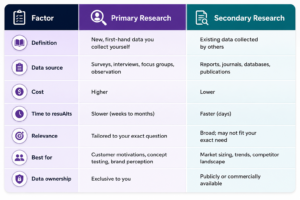
When to Use Primary vs Secondary Research
There is no universal research strategy that works for every business. The right choice depends on the decision you are trying to make. Use this quick framework:
Choose Primary Research When:
- You need customer motivations, preferences, or purchase behavior.
- You are testing a new product concept, message, or brand.
- The data you need does not exist yet or is not public.
- You need results that are exclusive to your organization.
Choose Secondary Research When:
- You need to size a market or understand industry trends quickly.
- You are mapping the competitive landscape.
- You have a limited budget or timeline.
- You want context and background before designing primary studies.
It Is Not About Choosing One -It Is About the Right Combination
A common misconception is that businesses must pick either primary or secondary research. In practice, the strongest insights come from combining both. Secondary research provides the broad picture -market conditions, industry developments, and competitive environments. Primary research then adds depth, validating those findings through direct conversations with customers, experts, and stakeholders. Together, they move an organization from assumptions to evidence-based decisions.
How HBG Knowledge Helps You Choose the Right Approach
Positioned as one of the best market research companies for global businesses, HBG Knowledge helps organizations select and execute the right balance of primary and secondary research. We do not just collect information -we transform it into clear, decision-ready intelligence.
Our primary market research connects you with the right respondents -decision-makers, industry professionals, and consumers across global markets -through surveys, interviews, focus groups, and expert consultations. For clients seeking primary research services in the U.S. and beyond, we pair local market insight with global research capabilities.
Our secondary research goes beyond data collection. Experienced analysts conduct extensive desk research, cross-check multiple credible sources, and validate data to uncover meaningful trends. With expertise across Healthcare & Pharmaceuticals, Technology & Telecommunications, Automotive, Financial Services, Consumer Goods, Energy, and Retail, HBG Knowledge turns complex market information into a solid foundation for strategy.
By combining both approaches, HBG Knowledge delivers customized market research for businesses that turns information into insight -and insight into confident decisions.
Frequently Asked Questions
What is the main difference between primary and secondary research?
Primary research is new data you collect first-hand through methods like surveys and interviews. Secondary research analyzes existing data from sources such as industry reports and databases. The core difference is who originally collected the data.
Which is better, primary or secondary research?
Neither is universally better. Secondary research is faster and cheaper and is best for context and market trends, while primary research is more precise and best for answering specific questions about your customers. Most effective strategies combine both.
Is secondary research cheaper than primary research?
Yes. Secondary research generally costs less and takes less time because the data already exists. Primary research requires designing a study, recruiting participants, and collecting and analyzing new data, which uses more resources.
Should I start with primary or secondary research?
Most projects should start with secondary research to build background knowledge and identify gaps. Primary research is then used to fill those gaps with fresh, targeted data -avoiding wasted spend on information that already exists.
Can primary and secondary research be used together?
Absolutely. Secondary research gives you the broad market picture, and primary research validates and deepens it with direct input from your audience. Combined, they provide a complete, evidence-based view of the market.
Why choose HBG Knowledge for market research?
HBG Knowledge is a global market research and business intelligence partner that designs the right mix of primary and secondary research for each client. With multilingual teams, global reach, and deep industry expertise, HBG Knowledge turns complex data into decision-ready intelligence.
Conclusion
The question is not whether primary or secondary research is better -it is which approach, or combination of approaches, best supports your business objectives. When you need direct customer perspectives, primary research delivers tailored insight. When you need market understanding and competitive intelligence, secondary research provides strategic direction. Used together, they build a stronger foundation for growth.
Ready to turn research into confident decisions? Talk to HBG Knowledge and get a customized primary and secondary research plan built around your goals.