
Why Telecom Companies Still Rely on CATI Surveys
Not every telecom research question can be answered by a customer. Some can only be answered by the people building, buying, and running the networks themselves.
Online surveys are well suited to reaching large numbers of subscribers quickly. But when the goal is understanding enterprise telecom adoption, network infrastructure investment, or how a CIO is evaluating 6G rollout plans, a different kind of respondent – and a different kind of conversation – is required.
That’s where CATI (computer-assisted telephone interviewing) continues to earn its place. In practice, online surveys are typically the tool for reaching customers at scale, while CATI is often the method of choice for reaching the experts, technical professionals, and decision-makers whose answers carry real strategic weight.
This article looks at why that distinction matters, where CATI delivers the most value in telecom B2B research, and what separates a well-run expert study from a shallow one.
Why Expert-Level Telecom Research Needs More Than Self-Service Surveys
B2B and expert research in telecom comes with a different set of constraints than consumer research – and they don’t disappear just because a survey moves online.
Hard-to-reach respondents. CIOs, network architects, and procurement leads rarely have time for an unsolicited survey link, and gatekeepers often stand between researchers and the right person.
Small, specialized respondent pools. Unlike a mass consumer market, the universe of qualified experts on a given topic – say, enterprise 6G deployment – may be a few hundred people worldwide. Every response needs to count.
Technical and strategic subject matter. Topics like network infrastructure investment or IoT adoption roadmaps involve context that a simple rating scale can’t capture.
Screening accuracy. A study on telecom procurement decisions is only useful if the respondent genuinely holds that authority – something that’s much easier to verify in a live conversation than a self-reported checkbox.
Sensitive, competitive information. Channel partners and enterprise buyers may be cautious discussing pricing, vendor evaluations, or competitive positioning without the trust a real conversation builds.
These factors mean that reaching the right expert isn’t just about survey design – it’s about the format of the conversation itself.
Why Live Conversations Work Better With Experts and Decision-Makers
A trained interviewer brings capabilities that a self-administered form simply doesn’t have when the respondent is a technical or executive-level professional.
- Verify credentials in real time. Interviewers can confirm a respondent’s role, seniority, and decision-making authority before the substantive interview even begins.
- Probe technical answers. If a network engineer gives a surface-level answer about infrastructure investment plans, an interviewer can ask a natural follow-up to get specifics.
- Build rapport with senior stakeholders. A short, professional phone conversation is often easier for a busy executive to commit to than a lengthy online form.
- Adapt language across audiences. The same study may need to speak differently to a CIO than to a field technician, and a skilled interviewer can adjust tone accordingly.
- Capture richer competitive intelligence. Open-ended, interviewer-led discussion tends to surface more nuanced insight on vendor comparisons and market positioning.
- Improve completion among niche audiences. When the qualified respondent pool is small, every completed interview matters, and live scheduling helps protect that yield.
None of this makes online research obsolete – it simply reflects that different respondents and different questions call for different tools.
When CATI Is the Right Method for Telecom B2B Research
CATI tends to deliver the most value in telecom research when the respondent is an expert, technical professional, or decision-maker rather than an end consumer.
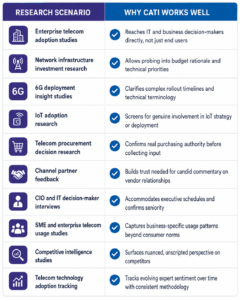
Some telecom organizations also use CATI for telecom customer satisfaction survey work with end subscribers – but HBG’s core differentiator lies in applying the same rigor to reach the harder-to-access experts and decision-makers who shape the industry from the inside.
What Makes a Successful Expert CATI Study – and How HBG Delivers It
Interviewing telecom experts and decision-makers well requires a different playbook than interviewing consumers – and reaching them at scale takes infrastructure most internal research teams don’t maintain in-house. This is exactly where HBG Knowledge builds its programs:
- Rigorous respondent screening and validation – confirming role, seniority, and genuine decision-making authority before data collection begins.
- Industry-experienced interviewers – trained in telecom, network, and enterprise IT vocabulary, not generic scripts.
- Ability to probe strategic and technical answers – going beyond a script to draw out real depth.
- Flexible scheduling – working around executive calendars, time zones, and tight B2B fieldwork timelines.
- Confidentiality assurances – essential for competitive or procurement-related topics.
- Multilingual capability – supporting global enterprise, channel partner, and B2B studies across markets.
- Careful data validation – checking responses against known professional profile criteria.
- Quality monitoring – live or recorded call review to maintain consistency across interviewers.
Skipping any of these steps tends to show up later – in unqualified respondents, shallow answers, or data that doesn’t hold up under scrutiny. Done well, the result is data that reflects the actual perspective of the people making telecom’s biggest decisions – not just the people using its services.
The Future of CATI in Telecom B2B Research
Online panels continue to expand what’s reachable at scale, particularly for broad consumer feedback. But the pool of qualified telecom experts, IT decision-makers, and channel partners remains comparatively small and hard to access through open panels alone.
Because of that, many B2B telecom research programs now combine methods deliberately: online outreach to identify and pre-qualify potential respondents, followed by CATI to conduct the actual expert interview once someone is confirmed. This blended approach uses each method for what it does best – scale on one side, depth and validation on the other.
Far from being outdated, CATI surveys remain the practical way to turn a hard-to-reach expert into a usable, decision-ready data point.
Conclusion
The distinction is a simple one: online surveys are typically built to reach customers for fast feedback, while CATI remains one of the most reliable ways to reach the experts and decision-makers whose input shapes telecom’s biggest strategic choices. For enterprise adoption studies, 6G and IoT research, procurement decisions, and competitive intelligence, that difference in respondent and conversation quality matters.
Choosing the right methodology is only half the equation. The other half is choosing a partner who knows how to find, qualify, and interview the right people – which is exactly what HBG Knowledge is built to do for telecom organizations worldwide.
If your team needs validated input from telecom experts and decision-makers. HBG Knowledge can help design and execute a CATI study built around your business objectives. Get in touch with HBG Knowledge today to discuss how expert-level research can strengthen your telecom strategy.
Read Also: Real-Time Actionable Insights: The Power of CATI Analytics